

LHD and RHD vehicles is one of the first decisions any international vehicle buyer must make. Get it wrong, and you risk port rejection, registration failure, or a vehicle that is simply impractical for your roads. This guide explains the difference between LHD vs RHD vehicles, maps out which African and Asian countries require each type, and shows why sourcing from the UAE gives you access to both without compromise.
Table of Contents
- 1. What LHD and RHD Actually Mean
- 2. Which African Countries Need LHD and Which Need RHD
- 3. Which Asian Countries Need LHD and Which Need RHD
- 4. Can You Register the Wrong Drive Type in Your Country?
- 5. How LHD vs RHD Affects Vehicle Pricing and Availability
- 6. Why the UAE Supplies Both LHD and RHD
- 7. What Milele Motors Stocks
- 8. Frequently Asked Questions
1. What LHD and RHD Actually Mean
LHD stands for Left-Hand Drive. The steering wheel sits on the left side of the vehicle. RHD stands for Right-Hand Drive. The steering wheel sits on the right side. These terms describe the steering wheel position — not the side of the road you drive on.
However, the two are directly linked. In countries where traffic drives on the right side of the road, the driver needs to sit on the left. So LHD vehicles are standard. In countries where traffic drives on the left, the driver sits on the right. So RHD vehicles are standard. According to current global traffic data [opens in new tab], 176 countries drive on the right (LHD) while 74 countries drive on the left (RHD).
Understanding this is essential before you import any vehicle. Additionally, choosing the wrong type creates real problems — from port rejection to unsafe overtaking conditions on local roads.
2. Which African Countries Need LHD and Which Need RHD
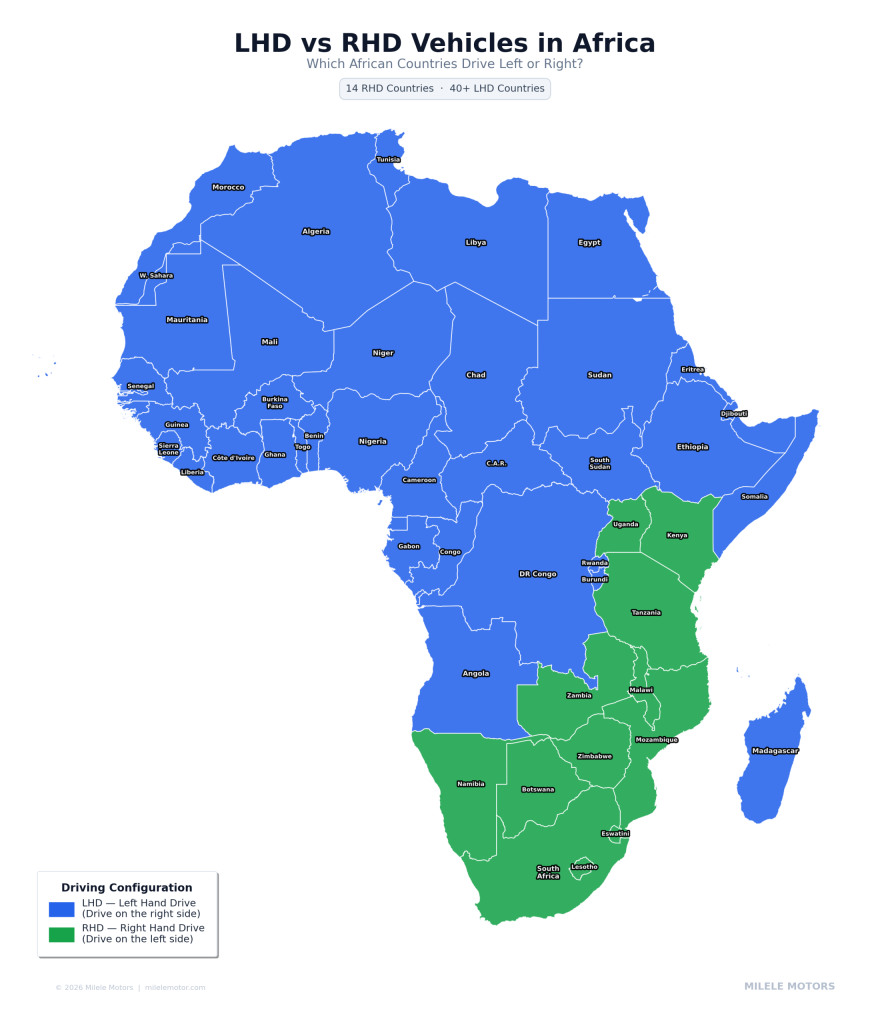
Africa is split between both systems. The divide follows colonial history almost exactly. Former British colonies drive on the left and use RHD vehicles. Most French, Portuguese, and Belgian former colonies drive on the right and use LHD vehicles.
RHD countries in Africa (drive on the left) — these countries require Right-Hand Drive vehicles:
- East Africa: Kenya, Tanzania, Uganda, Rwanda (border cases — check locally)
- Southern Africa: South Africa, Zambia, Zimbabwe, Botswana, Namibia, Malawi, Mozambique
- Small island nations: Mauritius, Seychelles, Lesotho, Eswatini
LHD countries in Africa (drive on the right) — these countries require Left-Hand Drive vehicles:
- West Africa: Nigeria, Ghana, Senegal, Côte d’Ivoire, Mali, Guinea, Sierra Leone, Liberia, Togo, Benin, Burkina Faso, Cameroon
- Central Africa: Democratic Republic of Congo, Republic of Congo, Chad, Central African Republic
- East & North Africa: Ethiopia, Sudan, Egypt, Morocco, Algeria, Tunisia, Libya, Djibouti
- Southern Africa: Angola
Therefore, always confirm your destination country’s rule before sourcing. Sending an LHD vehicle to Kenya, for example, will result in rejection at Mombasa Port and re-export at your cost.
3. Which Asian Countries Need LHD and Which Need RHD
Asia is predominantly LHD — however, some of the continent’s largest markets are RHD. The key distinction is between South and South-East Asian nations (mostly RHD due to British and Japanese influence) and mainland Asia and the Middle East (mostly LHD).
RHD countries in Asia (drive on the left) — require Right-Hand Drive vehicles:
- South Asia: India, Pakistan, Bangladesh, Sri Lanka, Nepal (check locally), Bhutan
- South-East Asia: Thailand, Malaysia, Singapore, Indonesia, Brunei
- East Asia: Japan, Hong Kong
LHD countries in Asia (drive on the right) — require Left-Hand Drive vehicles:
- Middle East (Milele’s home region): UAE, Saudi Arabia, Qatar, Kuwait, Bahrain, Oman, Jordan, Iraq, Iran, Yemen
- Central Asia: Kazakhstan, Uzbekistan, Turkmenistan, Kyrgyzstan, Tajikistan
- East Asia: China, South Korea, Taiwan, Vietnam, Cambodia, Laos, Philippines
Furthermore, the Middle East is entirely LHD — which aligns perfectly with UAE-sourced GCC-spec vehicles that are already left-hand drive. This makes the UAE an ideal export hub for buyers across the Middle East and most of West Africa.
4. Can You Register the Wrong Drive Type in Your Country?
In most countries, both LHD and RHD vehicles can technically be owned and driven. However, registering the non-standard type is often complicated and sometimes restricted. A small number of countries do formally prohibit registration of the wrong configuration.
Saudi Arabia, for example, formally restricts RHD vehicle registration in its right-hand traffic environment. Sierra Leone has similar restrictions. Taiwan has also applied limitations. However, in most African and Asian markets, the registration is legally possible — but it creates practical problems.
Operating the wrong drive type is genuinely dangerous. A right-hand drive vehicle in a right-hand traffic country (like Nigeria) places the driver on the wrong side to judge overtaking safety. Most buyers choose to source the correct configuration from the outset. It is always the smarter, safer, and simpler option.
As noted by global traffic convention guides [opens in new tab], the standard configuration is rarely a legal requirement but is nearly always the practical one.
5. How LHD vs RHD Affects Vehicle Pricing and Availability
LHD vehicles are produced in far higher volumes globally because the majority of countries drive on the right. This makes LHD vehicles slightly more available and competitively priced across most markets. RHD vehicles are manufactured in large volumes for specific markets — Japan, the UK, India, Thailand — and are widely available through exporters serving those markets.
From the UAE, both configurations are accessible. GCC-specification vehicles from the UAE domestic market are LHD — making the UAE an excellent source for West African buyers (Nigeria, Ghana, Senegal), Middle Eastern buyers, and Central Asian importers. RHD vehicles sourced through the UAE, originally from Japan or other RHD markets and re-exported, serve East African and South Asian buyers very effectively.
The key point is this: unlike exporters based in Japan (primarily RHD) or the United States (primarily LHD), a UAE-based exporter with full stock access gives buyers from any country the exact configuration they need — from a single supplier, with unified documentation and logistics.
6. Why the UAE Supplies Both LHD and RHD
The UAE sits at the crossroads of global vehicle trade. Dubai’s Jebel Ali Port handles vehicle cargo from Japan, the United States, Europe, and the wider GCC. This means UAE-based exporters have access to both LHD and RHD inventory simultaneously — a flexibility that most other export origins simply cannot offer.
Additionally, the UAE’s free zone structure means vehicles can be imported, re-conditioned, and re-exported without complex duties or restrictions. A dealer in Nigeria can order LHD Toyota Land Cruisers. At the same time, a dealer in Kenya can order RHD Toyota Hilux pickups. Both orders can come from the same UAE supplier, with the same documentation process, and ship from the same port.
This is one of the core operational advantages of sourcing from the UAE — and one of the main reasons why the UAE accounts for such a significant share of vehicle exports to both Africa and Asia.
7. What Milele Motors Stocks
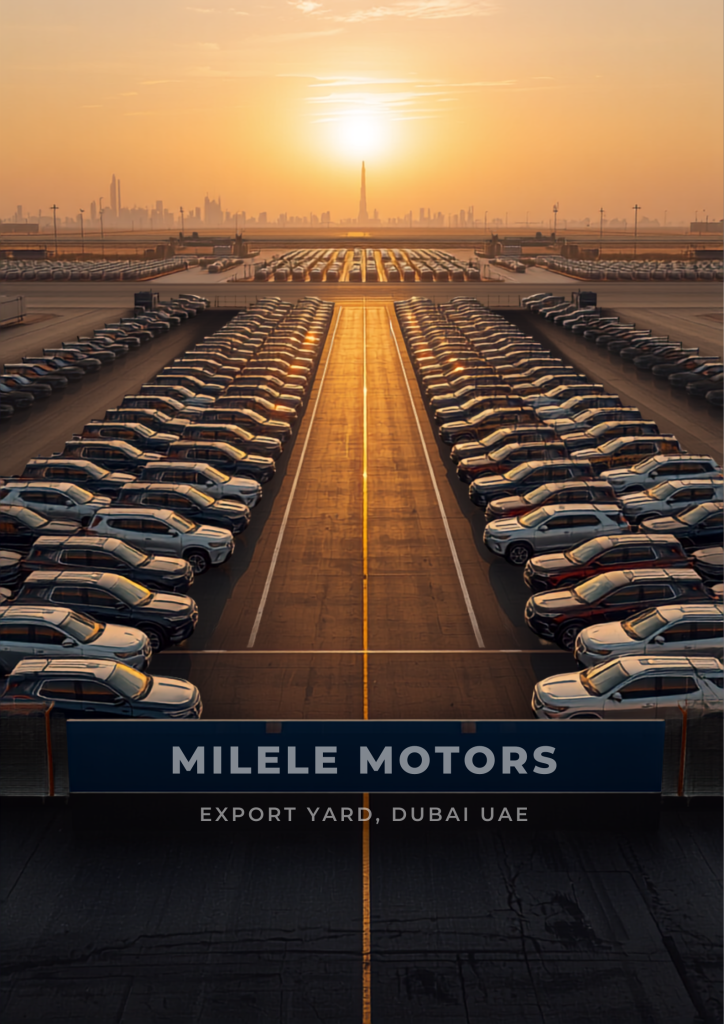
Milele Motors maintains LHD and RHD inventory across all vehicle categories. Our stock covers passenger cars, SUVs and 4x4s, commercial pickups and trucks, off-road vehicles, ambulances and emergency vehicles, and spare parts — in both configurations.
For buyers sourcing across multiple markets simultaneously, we can handle mixed LHD and RHD orders in a single transaction. We confirm the correct specification for your destination country before any vehicle is committed to your order. If you are unsure which type you need, our export team will advise based on your destination.
With over 40 years of export experience and 100,000+ vehicles shipped, we understand the specific requirements of every major African and Asian market. No order leaves our yard in the wrong specification.
Ready to order? Contact the Milele Motors team for availability and pricing, or browse our full inventory now.
8. Frequently Asked Questions
How do I know if I need an LHD or RHD vehicle?
Find out which side of the road traffic drives on in your country. If traffic drives on the right, you need an LHD vehicle. If traffic drives on the left, you need an RHD vehicle. In Africa, most East and Southern African countries (Kenya, Tanzania, South Africa, Zambia) drive on the left and need RHD. Most West and Central African countries (Nigeria, Ghana, Senegal) drive on the right and need LHD.
Can I convert an LHD vehicle to RHD after purchase?
Technically possible but extremely expensive. Conversion requires reconfiguring the steering column, pedal assembly, dashboard, airbag systems, and safety certifications. In practice, the cost almost always exceeds the value of the vehicle. It is always more cost-effective to source the correct specification from the start through a supplier like Milele Motors who stocks both types.
Does Milele Motors stock both LHD and RHD vehicles?
Yes. Milele Motors maintains inventory in both LHD and RHD configurations across all vehicle categories — passenger cars, SUVs, pickups, trucks, ambulances, off-road vehicles, and emergency vehicles. We confirm the correct specification for your destination country before any order is confirmed.
Is it legal to drive an RHD vehicle in an LHD country?
In most countries, yes — technically legal but practically inconvenient and sometimes dangerous. A small number of countries (Saudi Arabia, Sierra Leone, Taiwan) do formally restrict registration of the non-standard configuration. In most African and Asian markets, registration is possible but the wrong drive type creates real safety issues, particularly when overtaking.
What is the most popular LHD vehicle exported from the UAE to West Africa?
Toyota Land Cruiser and Toyota Hilux are the most popular LHD models exported to West African markets like Nigeria and Ghana. Both models come in LHD GCC-specification from the UAE and are highly valued for their durability on West African roads. Milele Motors stocks both models in LHD configuration.